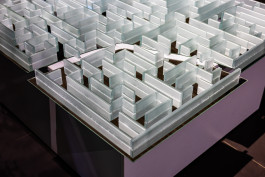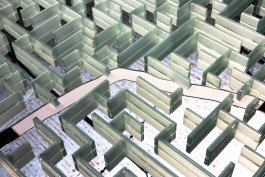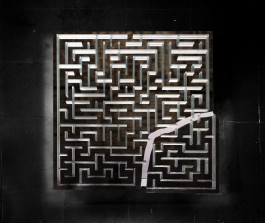

During March and July 2026, I undertook a research stay at the Glass Department of the Tbilisi State Academy of Arts in Georgia, exploring embodied knowledge through the practice of glass cutting. The final result was a glass mosaic, The Broken Labyrinth.
Although the physical outcome of the work is important, it remains secondary to the process through which it was produced. The research focuses on the embodied act of scoring, cutting, and assembling glass. More specifically, the project investigates freehand scoring as a method through which knowledge is developed through direct physical engagement with the material. Unlike approaches in which precision is primarily controlled by external tools, freehand scoring requires the maker to rely on visual judgment, bodily awareness, and accumulated experience.
Conceptually, the labyrinth represents the structures and borders that shape everyday life. Freedom is no longer achieved by finding the correct path within the system but by leaving the system altogether. The crack itself becomes the true path: an escape beyond established norms and prescribed ways of thinking.
Throughout its production, colleagues from the Glass Department participated in lifting, transporting, positioning, and assembling the individual components. The project therefore extends the investigation of embodied knowledge beyond the relationship between maker and material to encompass collaboration, highlighting how knowledge is also created through shared physical labour and relationships between people
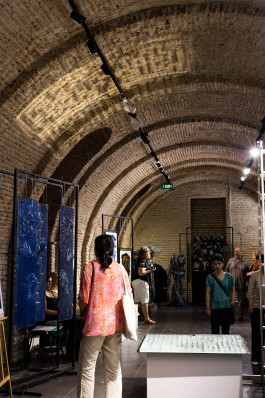
The work will become part of the collection of the Museum of the Tbilisi State Academy of Arts, Tbilisi, Georgia.
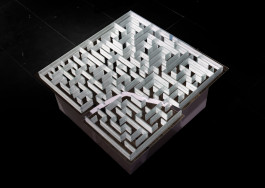
Float glass, free hand cutting, 125 x 125 x 10 cm
Photo Credits: Giorgi Lomidze


↑

During March and July 2026, I undertook a research stay at the Glass Department of the Tbilisi State Academy of Arts in Georgia, exploring embodied knowledge through the practice of glass cutting. The final result was a glass mosaic, The Broken Labyrinth.
Although the physical outcome of the work is important, it remains secondary to the process through which it was produced. The research focuses on the embodied act of scoring, cutting, and assembling glass. More specifically, the project investigates freehand scoring as a method through which knowledge is developed through direct physical engagement with the material. Unlike approaches in which precision is primarily controlled by external tools, freehand scoring requires the maker to rely on visual judgment, bodily awareness, and accumulated experience.
Conceptually, the labyrinth represents the structures and borders that shape everyday life. Freedom is no longer achieved by finding the correct path within the system but by leaving the system altogether. The crack itself becomes the true path: an escape beyond established norms and prescribed ways of thinking.
Throughout its production, colleagues from the Glass Department participated in lifting, transporting, positioning, and assembling the individual components. The project therefore extends the investigation of embodied knowledge beyond the relationship between maker and material to encompass collaboration, highlighting how knowledge is also created through shared physical labour and relationships between people
The work will become part of the collection of the Museum of the Tbilisi State Academy of Arts, Tbilisi, Georgia.

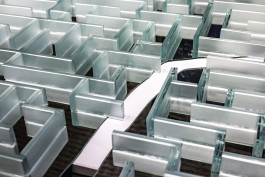
Float glass, free hand cutting, 125 x 125 x 10 cm
Photo Credits: Giorgi Lomidze


↑